Showcase Digitales Impfdossier - Interoperabilität durch Standards
Interoperabilität im Gesundheitswesen - FHIR für Austausch, openEHR für Persistenz, Showcase Impfen
Challenge Story
Check out additional videos below for more details.
Challenge Language
This challenge was initially submitted in German. However, all documentation will be provided in English, in order to reach an international target audience.
Check out the briefing section below for a quick overview of the challenge objectives.
Challenge Submission Text
Bedarf/Problem und Zielgruppe
Diese Challenge ist Teil einer Gesamt-Initiative am GovTech Hackathon 2026 - https://drive.google.com/drive/u/0/folders/1YrEa5u3LyTDjOOz--Fnd38N4E9kpILdD
Weitere Informationen zu dieser Challenge sind zu finden im Ordner - https://drive.google.com/drive/u/0/folders/1YrEa5u3LyTDjOOz--Fnd38N4E9kpILdD
Diese Challenge fokussiert auf das Zusammenspiel von HL7 FHIR und openEHR auf einer offenen Datenplattform mit Open-Source-Komponenten. Ziel ist es, anhand eines konkret verständlichen Anwendungsfalls zu zeigen, wie sich diese beiden internationalen Standards im Gesundheitswesen sinnvoll ergänzen: FHIR für Interoperabilität und Datenaustausch, openEHR für persistente und longitudinale klinische Datenspeicherung.
Als exemplarischer Anwendungsfall wird das digitale Impfdossier gewählt. Impfungen eignen sich besonders gut, weil sich daran die Notwendigkeit einer langfristigen, lebenslangen und konsistenten Speicherung medizinischer Daten besonders gut zeigen lässt. Der Showcase soll damit einen Proof of Concept für FHIR-basierten Datenaustausch und openEHR-basierte Persistenz auf einer offenen Plattform liefern.
Im Gesundheitswesen werden Daten heute häufig entweder standardisiert ausgetauscht oder intern langfristig und strukturiert gespeichert, jedoch nur selten in einer Weise, die beide Anforderungen überzeugend verbindet. Es fehlt an praxisnahen Beispielen, die zeigen, wie internationale Standards wie FHIR für den Datenaustausch und openEHR für die klinische Langzeitpersistenz auf einer offenen Plattform sinnvoll zusammenspielen können.
Gerade bei medizinischen Informationen, die über viele Jahre oder ein ganzes Leben relevant bleiben, braucht es eine belastbare, strukturierte und semantisch robuste Langzeitspeicherung. Dies ist beim Impfdossier besonders offensichtlich: Impfungen müssen über lange Zeiträume nachvollziehbar dokumentiert, wiederverwendbar gespeichert und systemübergreifend ausgetauscht werden können.
Betroffen sind insbesondere Gesundheitsfachpersonen, die Impfungen dokumentieren, einsehen und über Systemgrenzen hinweg nutzen, Hersteller von Primärsystemen und Gesundheitsanwendungen, die interoperable Lösungen umsetzen, sowie Organisationen, die offene Gesundheitsplattformen oder Interoperabilitätslösungen aufbauen. Mittel- bis langfristig betrifft das Thema auch Bürgerinnen und Bürger, die von einem verlässlichen digitalen Impfdossier mit nachvollziehbaren und langfristig verfügbaren Impfdaten profitieren.
(Nicht) verfügbare Daten
Verfügbar sind die offizielle Schweizer CH VACD FHIR-Spezifikation, bereits vorhandene openEHR-Modellierungen von Impfdaten, Architekturentwürfe für eine offene Plattform, konzeptionelle Überlegungen zu einem Interoperabilitätslayer bzw. zu Interoperabilitätsservices, öffentlich verfügbare Standards, Profile und Terminologien sowie fachliche und technische Expertise in den Bereichen openEHR, FHIR, Modellierung und Architektur.
Darüber hinaus stehen Open-Source-Komponenten als technische Grundlage für den Proof of Concept zur Verfügung.
Nicht vorgesehen sind produktive Personendaten oder produktive klinische Daten. Für den Hackathon werden stattdessen synthetische und beispielhafte Daten bereitgestellt.
Erwarteter Nutzen
Es entsteht ein konkreter und nachvollziehbarer Nachweis, dass FHIR-basierter Datenaustausch und openEHR-basierte klinische Langzeitpersistenz auf einer offenen Datenplattform mit Open-Source-Komponenten in der Praxis sinnvoll zusammen funktionieren.
Der Mehrwert besteht in einem sichtbaren Proof of Concept für das Zusammenspiel zweier internationaler Standards, in einer belastbaren Architekturidee mit Interoperabilitätslayer sowie in einer lebenslangen, konsistenten Datengrundlage für Impfdaten. Gleichzeitig liefert der Showcase eine Blaupause für weitere klinische Inhalte, schafft eine Grundlage für ein digitales Impfdossier und ebnet den Weg für einen Ausbau in Richtung International Patient Summary (IPS).
Mit dem digitalen Impfdossier hat jeder Bürger hat seinen gesamten Impfverlauf jederzeit strukturiert und digital verfügbar und kann diesen bei Bedarf bei Gesundheitsfachpersonen und Behörden in der Schweiz und im Ausland vorweisen. Darauf aufbauend lassen sich Folgeimpfungen sowie Impf-Empfehlungen für Auslandsreisen ableiten. Darüber hinaus kann eine verantwortliche Person Impfungen für die Familie koordinieren (z.B. Eltern für ihre Kinder).
Ziel für den Hackathon
Erstellung einer ersten Version eines Showcases für eine App, basierend auf den internationalen Standards openEHR für die semantische klinische Persistierung sowie FHIR für den interoperablen Austausch. Der Showcase soll anschliessend als Initiative von openEHR Schweiz (https://openehr.atlassian.net/wiki/spaces/oech/pages/3468427363/2026+Showcase+Impf-Modul) weiterentwickelt werden, um Investoren für eine produktive Einführung zu erreichen.
Lösungsansätze
Grundsätzlich gibt es für diese Challenge verschiedene Lösungsansätze auf Ebene von Standards, Plattform und Architektur. Bereits erarbeitet wurden Architekturüberlegungen zum Zusammenspiel von Austausch, Persistenz und Interoperabilitätslayer. Darüber hinaus wurden bewährte technische Bausteine für eine offene Plattform identifiziert, die im Proof of Concept eingesetzt werden können, insbesondere Komponenten für FHIR, openEHR, Interoperabilitätsservices sowie für die Datenkonvertierung bzw. das Mapping zwischen beiden Standards.
Im Bereich Impfdossier gab es in der Schweiz bereits Vorläufer und Teillösungen: meineimpfungen.ch bot gute Funktionalitäten, wurde jedoch wegen Sicherheitsmängeln ausser Betrieb genommen. eHealth Suisse hat einen rein FHIR-basierten elektronischen Impfausweis entwickeln lassen, der in einigen Gemeinschaften im elektronischen Patientendossier (EPD) verfügbar ist. Zudem wurde bereits ein Prototyp einer Gesundheits-App (https://youtu.be/T5bYmy_oXMo) für Bürgerinnen und Bürger erstellt, die produktive Einführung wurde jedoch bis zu einer geeigneten EPD-Anbindung zurückgestellt.
Einschränkungen
Die Challenge ist als Proof of Concept konzipiert und nicht als vollständige Produktivlösung. Der Fokus liegt bewusst auf dem Zusammenspiel von FHIR und openEHR und nicht auf der vollständigen Abdeckung aller fachlichen Prozesse rund um das Impfen.
Wichtig für die Challenge sind die Orientierung an der Schweizer CH VACD FHIR-Spezifikation für den Austausch und an openEHR für die persistente klinische Speicherung, die Verwendung von synthetischen Daten, der Einsatz von offenen Standards und Open Source Komponenten sowie eine Architektur, die als offene Plattform und als Grundlage für eine spätere Weiterentwicklung konzipiert ist.
Ebenfalls wichtig ist, dass der entwickelte Programmcode zusammen mit der notwendigen Dokumentation vollständig und nachvollziehbar über GitHub (wird vorbereitet) bereitgestellt wird.
Nachhaltigkeit
Der Hackathon Challenge ist eine gemeinsame Initiative von openEHR Schweiz und HL7 Schweiz. Es ist bereits geplant, den Showcase bis 3Q2026 weiterzuentwickeln, um diesen Investoren vorstellen zu können. Zudem sollen die Erfahrungen mit dem Showcase als «Blaupause» für die Umsetzung weiterer Elemente im «International Patient Summary» (IPS, https://international-patient-summary.net) dienen, z.B. Allergien, Medikation.
*** English text ***
Showcase Digital Vaccination Record - Interoperability Through Standards
Interoperability in Healthcare - FHIR for Data Exchange, openEHR for Data Persistence; Vaccination Showcase
Need/Problem and Target Audience
This challenge is part of an overall initiative at the GovTech Hackathon 2026 - https://drive.google.com/drive/u/0/folders/1YrEa5u3LyTDjOOz--Fnd38N4E9kpILdD
More information about this challenge can be found in the folder - https://drive.google.com/drive/u/0/folders/1YrEa5u3LyTDjOOz--Fnd38N4E9kpILdD
This challenge focuses on the interaction between HL7 FHIR and openEHR on an open data platform with open-source components. The objective is to demonstrate - using a specific and widely understandable use case - how these two international healthcare standards meaningfully complement each other: FHIR for interoperability and data exchange, openEHR for persistent and longitudinal clinical data storage.
The digital vaccination record is chosen as an exemplary use case. Vaccinations are particularly suitable since they demonstrate the necessity of long-term, lifelong, and consistent storage of medical data. The showcase is intended to provide a proof of concept for FHIR-based data exchange and openEHR-based persistence on an open platform. In today’s healthcare environments, data is often either standardized for exchange or internally stored in a long-term and structured manner, but rarely in a way that convincingly combines both requirements. There is a lack of practical examples that show how international standards like FHIR for data exchange and openEHR for long-term clinical persistence can work together meaningfully on an open platform.
Particularly for medical information that remains relevant for many years or an entire lifetime, reliable, structured, and semantically robust long-term storage is required. This is especially evident with vaccination records: vaccinations must be documented comprehensibly over long periods, stored reusably, and exchanged across systems. Affected stakeholders include healthcare professionals who document, view, and use vaccinations across system boundaries, providers of primary systems and healthcare applications implementing interoperable solutions, and organizations building open health platforms or interoperability solutions. In the medium to long term, the topic also affects citizens who benefit from a reliable digital vaccination record with traceable and long-term available vaccination data.
Available (and unavailable) Data
Examples of available data are the official Swiss CH VACD FHIR specification, existing openEHR models of vaccination data, architectural designs for an open platform, conceptual considerations for an interoperability layer or interoperability services, publicly available standards, profiles and terminologies, as well as professional and technical expertise in openEHR, FHIR, modeling, and architecture.
In addition, open-source components are available as a technical foundation for the proof of concept.
Production personal data or production clinical data are not intended. Instead, synthetic and exemplary data will be provided for the hackathon.
Expected Benefit
A specific and comprehensive proof shall emerge, demonstrating that FHIR-based data exchange and openEHR-based long-term clinical persistence work together meaningfully in practice on an open data platform with open-source components.
The added value consists of a tangible proof of concept for the interaction of two international standards, a reliable architecture concept with an interoperability layer, and a lifelong, consistent data foundation for vaccination data. At the same time, the showcase provides a blueprint for additional clinical content, creates a foundation for a digital vaccination record, and paves the way for expansion toward the International Patient Summary (IPS).
With the digital vaccination record, every citizen has their entire vaccination history available digitally and in a structured form at all times and can present it to healthcare professionals and authorities in Switzerland and abroad as needed. Based on this, follow-up vaccinations and vaccination recommendations for foreign travel can be derived. Furthermore, a responsible person can coordinate vaccinations for the family (e.g., parents for their children).
Objective for the Hackathon
Creation of a first version of an end-to-end showcase for an app based on the international standards openEHR for semantic clinical persistence and FHIR for interoperable exchange. The showcase shall subsequently be further developed as an initiative of openEHR Switzerland (https://openehr.atlassian.net/wiki/spaces/oech/pages/3468427363/2026+Showcase+Impf-Modul) to reach investors for production introduction.
Solution Approaches
Fundamentally, there are various solution approaches for this challenge at the level of standards, platform, and architecture. Architectural considerations on the interaction of exchange, persistence, and interoperability layer have already been developed. In addition, proven technical building blocks for an open platform have been identified that can be used in the proof of concept, particularly components for FHIR, openEHR, interoperability services, and for data conversion or mapping between both standards.
In the vaccination record area, there were already predecessors and partial solutions in Switzerland: meineimpfungen.ch offered good functionality but was taken out of service due to security deficiencies. eHealth Suisse had a purely FHIR-based electronic vaccination certificate developed, which is available in some communities in the electronic patient record (EPD). Additionally, a prototype of a health app (https://youtu.be/T5bYmy_oXMo) for citizens was already created, but the production introduction was postponed until an EPD API for such apps becomes available.
Limitations
The challenge is designed as a proof of concept and not as a complete production solution. The focus is deliberately on the interaction between FHIR and openEHR and not on the complete coverage of all professional processes around vaccination.
Important for the challenge: orientation towards the Swiss CH VACD FHIR specification for exchange and to openEHR for persistent clinical storage, use of synthetic data, deployment of open standards and open-source components, and an architecture designed as an open platform and as a foundation for later development.
It is also important that the developed program code, together with the necessary documentation, is provided completely and comprehensibly via GitHub (being prepared).
Sustainability
The hackathon challenge is a joint initiative of openEHR Switzerland and HL7 Switzerland. It is already planned to further develop the showcase until Q3 2026 in order to present it to investors. Additionally, the experiences with the showcase shall serve as a «blueprint» for implementing further elements of the «International Patient Summary» (IPS, https://international-patient-summary.net), e.g., allergies, medication.
Briefing
Challenge Objective
- The main objective of this challenge is to demonstrate the end-to-end implementation of FHIR and openEHR international standards in a showcase, based on the vaccination use case
- The secondary objective is to demonstrate user oriented «apps» for data producers and consumers - «vibe coding» can be used for rapid prototyping (see Claude prototype in resources below)
A key objective of the showcase is to serve as blueprint for future clinical use cases.
Envisaged Architecture
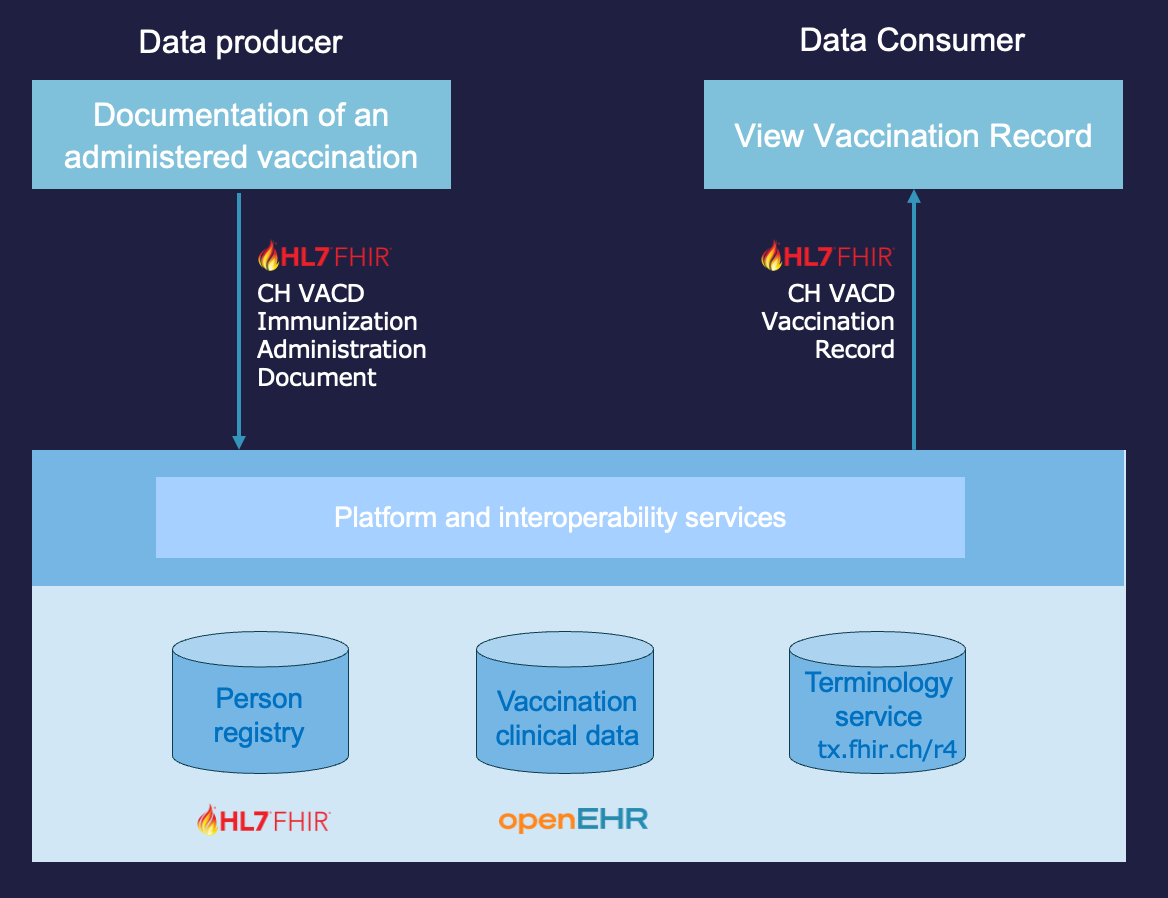
A framework of the openEHR/FHIR stack is available in the challenge GitHub repository to serve as development harness.
Vibe coding (i.e. AI supported coding) is envisaged for the hackathon prototype.
Ambition
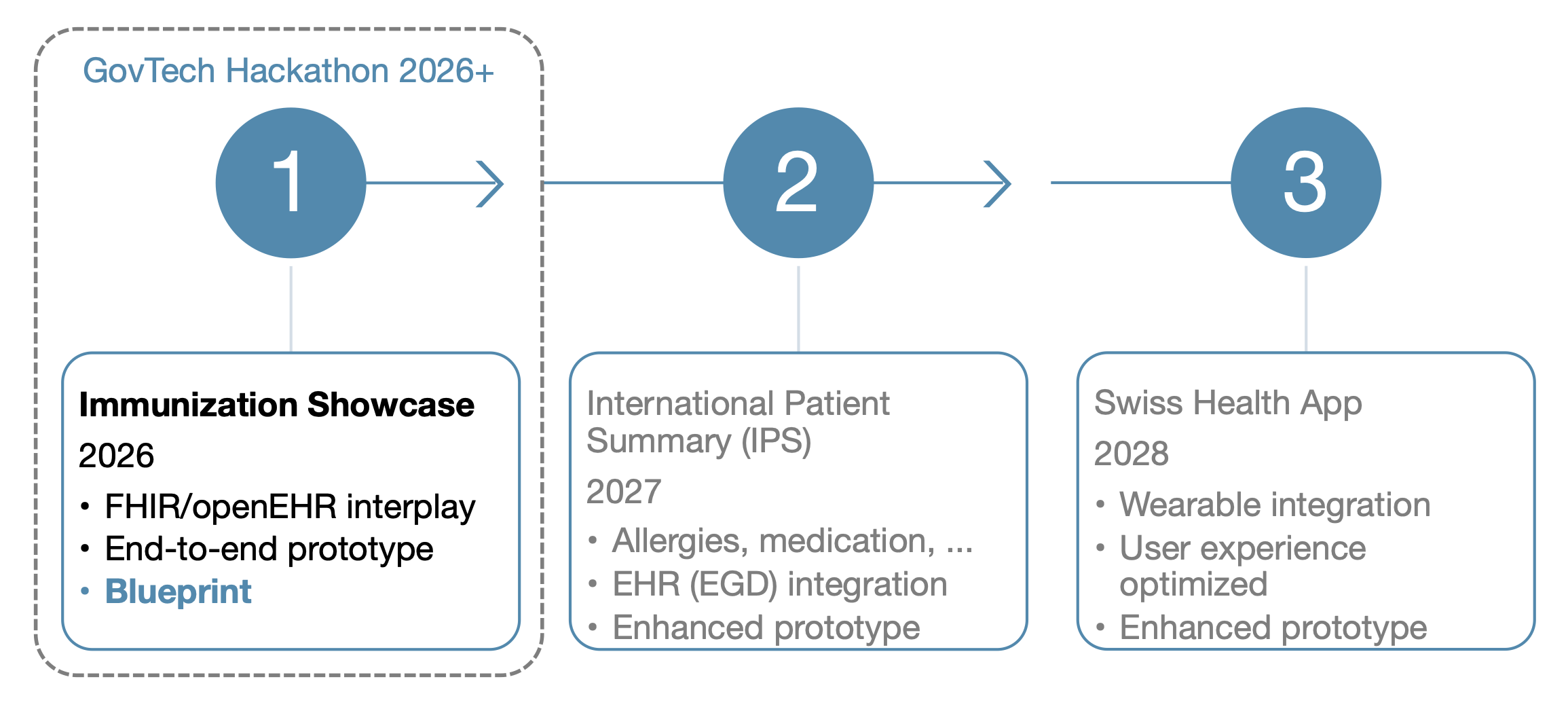
The ambition of our team is to establish a «Swiss Health App» which is as popular as the Swiss Federal Railway App, based n the following steps:
- Complete the Immunization Showcase - 2026
- Demonstrate openEHR/FHIR interplay
- Implement end-to-end prototype
- Establish blue print for future clinical use cases
- Extend to International Patient Summary (IPS) - 2027
- Extend prototype with additional use cases allergies, medication, ...
- Integrate official EHR (EGD)
- Extend to «Swiss Health App» - 2029
- Extend prototpe with wearable information
- Optimize user experience towards «health information at the fingertips»
Resources
- Challenge preparation area, contains collaboration area
- Challenge collaboration area - working area for challenge team, more documents
- Challenge GitHub repository
- Challenge Teams chat channel
- Challenge project on Renku platform
- openEHR International
- openEHR Switzerland
- HL7 FHIR
- HL7 Switzerland
- International Patient Summary (IPS)
- DigiSanté
- ...
More Resources
- «Digital Health with the new E-ID trust infrastructure», award winning GovTech Hackathon 2024 challenge, see documentation, short video, resources
- IPS Health app prototype, short video
- IPS prototype with Claude in 30 minutes, short video
- Interview with Katrin Crameri, Co-Lead DigiSanté; bfs info, Die Schweiz im Hintertreffen: Digitalisierung im Gesundheitswesen
- PhD Thesis Ralph Baumgartner, Digitale Geschäftsmodelle im Schweizer Gesundheitswesen: theoretische und empirische Analyse ihrer Wirkung auf integrierte Versorgung
- ...
Please note also the associated health challenge «30 Seconds to EGD» of this GovTech Hackathon 2026.
Project Documentation
Project Team
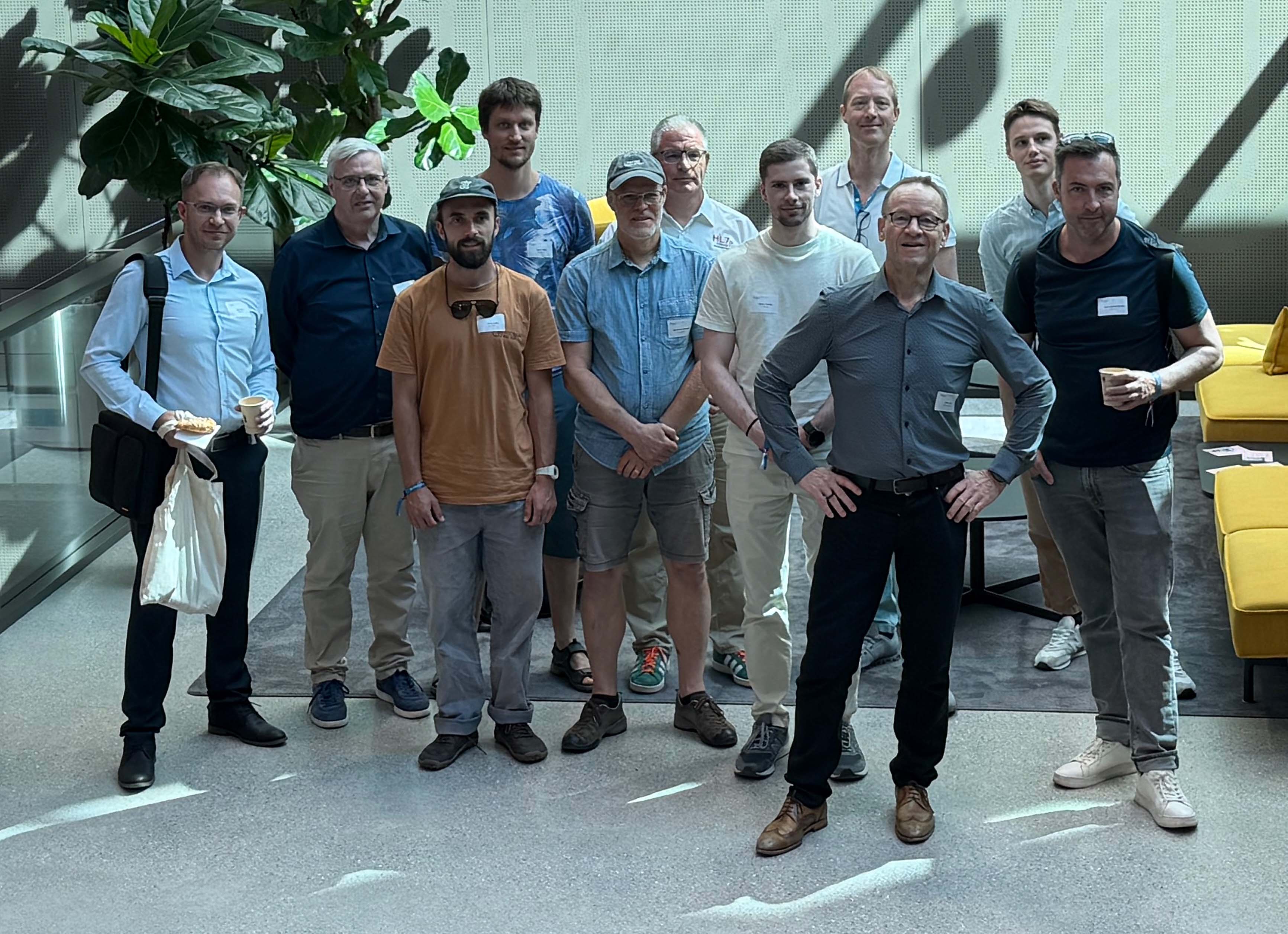
- Peter Janes, challenge owner, openEHR Switzerland Board of Directors, DIDAS Health working group lead, founder and CEO of Abdagon AG
- Jean-Pierre Messerli, openEHR modeling expert, openEHR Switzerland data modeling group member, Senior Consultant at JPM Consultung GmbH
- Roeland Luykx, FHIR expert, Chair HL7 Switzerland, founder and CEO of RALY GmbH
- Oliver Deak, technical expert, founder and CEO of Valico AG
- Gasper Andrejc, openEHR/FHIR expert, founder of openFHIR
- Paul Schell
- Andreas Schweizer
- Simon Koller
- Simon Schweingruber
- Fabian Santi
- Fabien Tschanz
Supporters
- Hendrik Heiser, CISTEC AG, Clinical Data Modeler, openEHR.ch Data Modeling Group chair
- Fabian Bürki, Federal Office of Public Health, FOPH (BAG), Standards, openEHR.ch Data Modeling Group member
- Paul Spicher, Federal Office of Public Health, FOPH (BAG), Scientific Advisor Digital Health
High Level Program
Thu, 28.05.2026 - Day 1
- Team Introduction
- Challenge Briefing
- Organization - Peter Janes
- openEHR - Jean-Pierre Messerli
- FHIR - Roeland Luykx
- Development Framework - Oliver Deak
- Getting into framework
- 16:30 challenge technical Q&A - Teams Link
- Preparing test data
- Documentation (ongoing)
Fri, 29.05.2026 - Day 2
- Extending framework stack
- 09:00 briefing call, review achieved results, plan remaining activities (including final pitch) - Teams Link, Recording
- openEHR/FHIR mappings
- Front end development
- Documentation (ongoing)
- Final pitch preparation
28.05.2026 - Day 1
Initial Pitch
Finding room, preparing for work
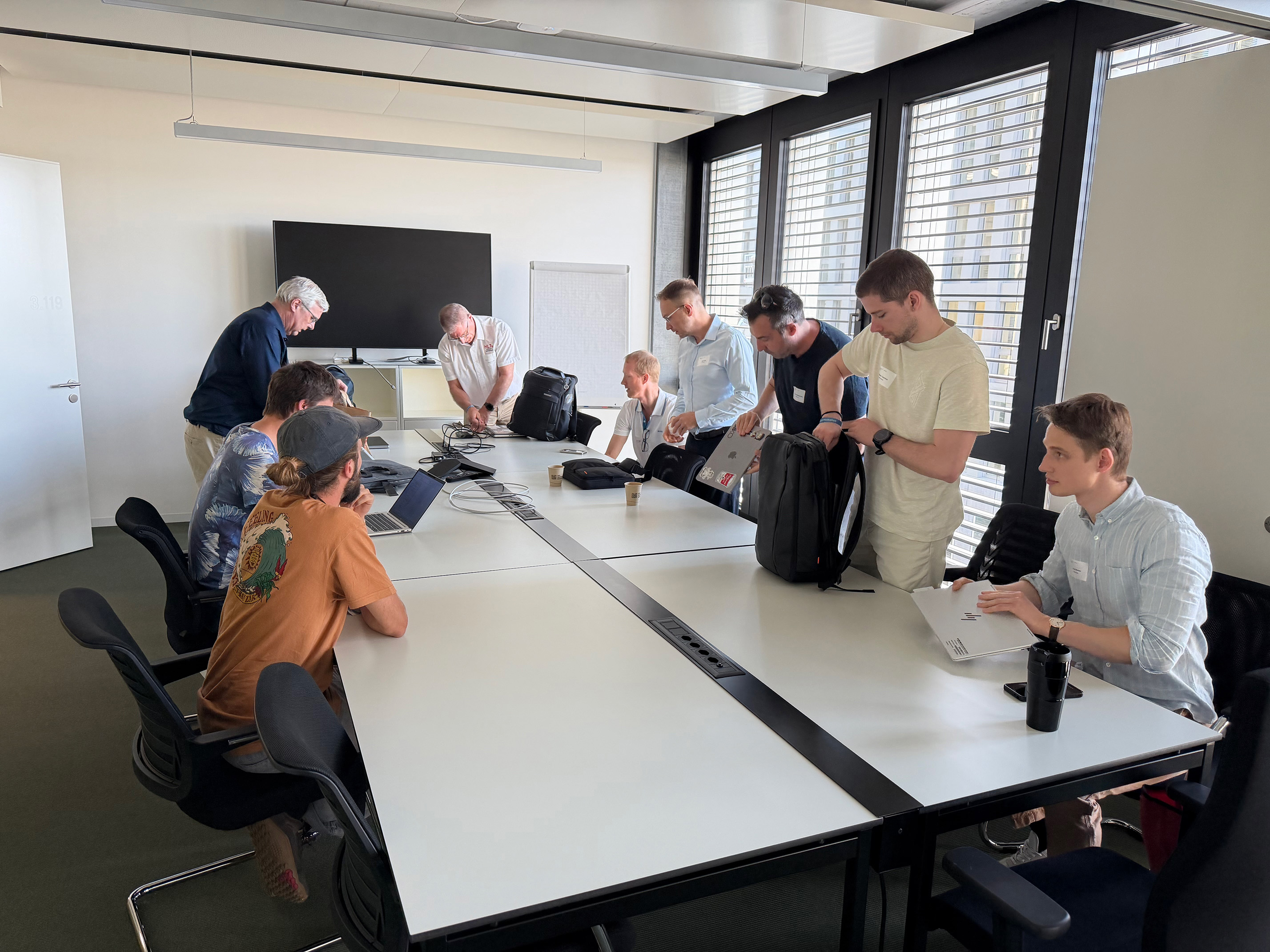
Challenge briefing
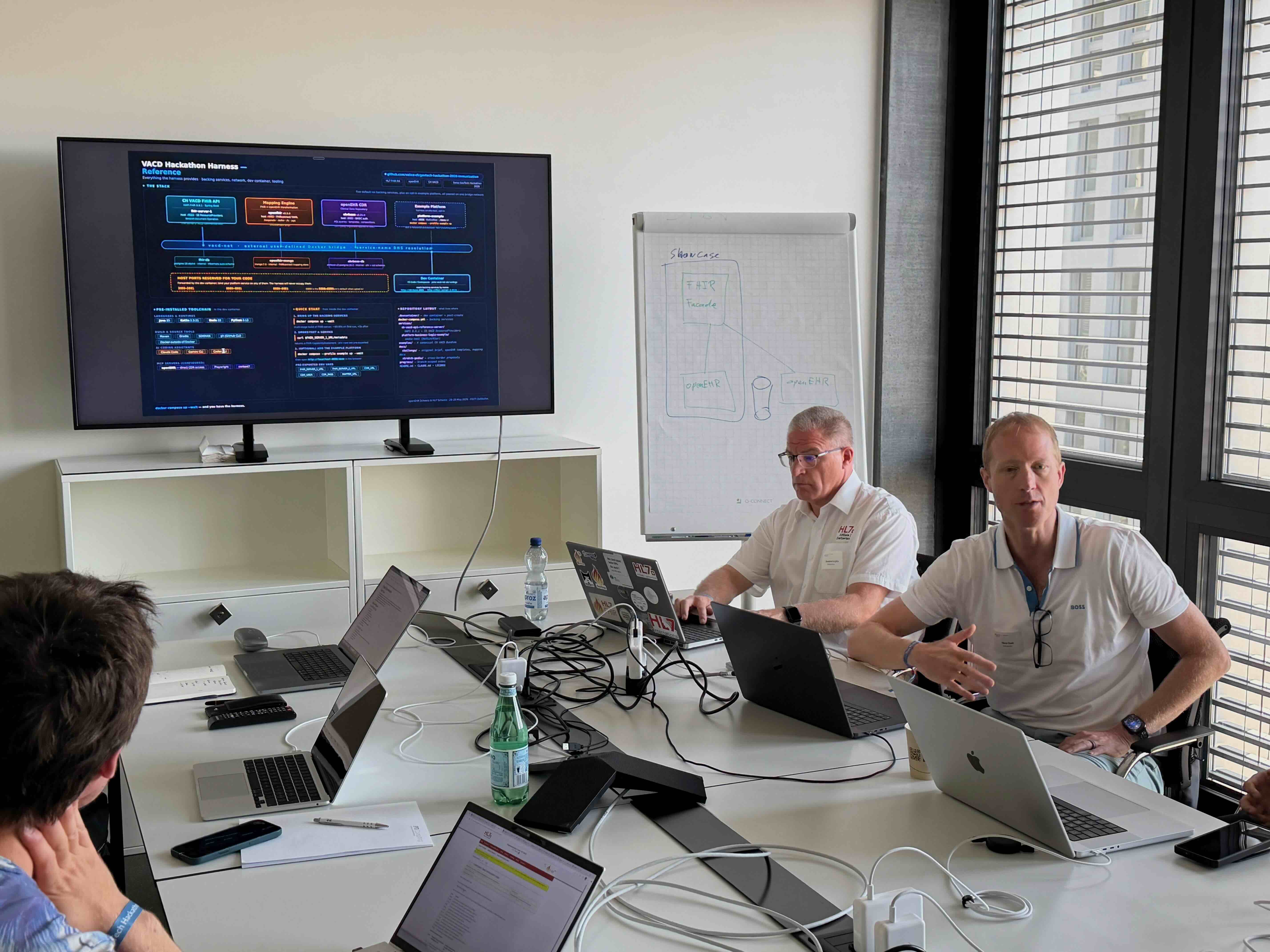
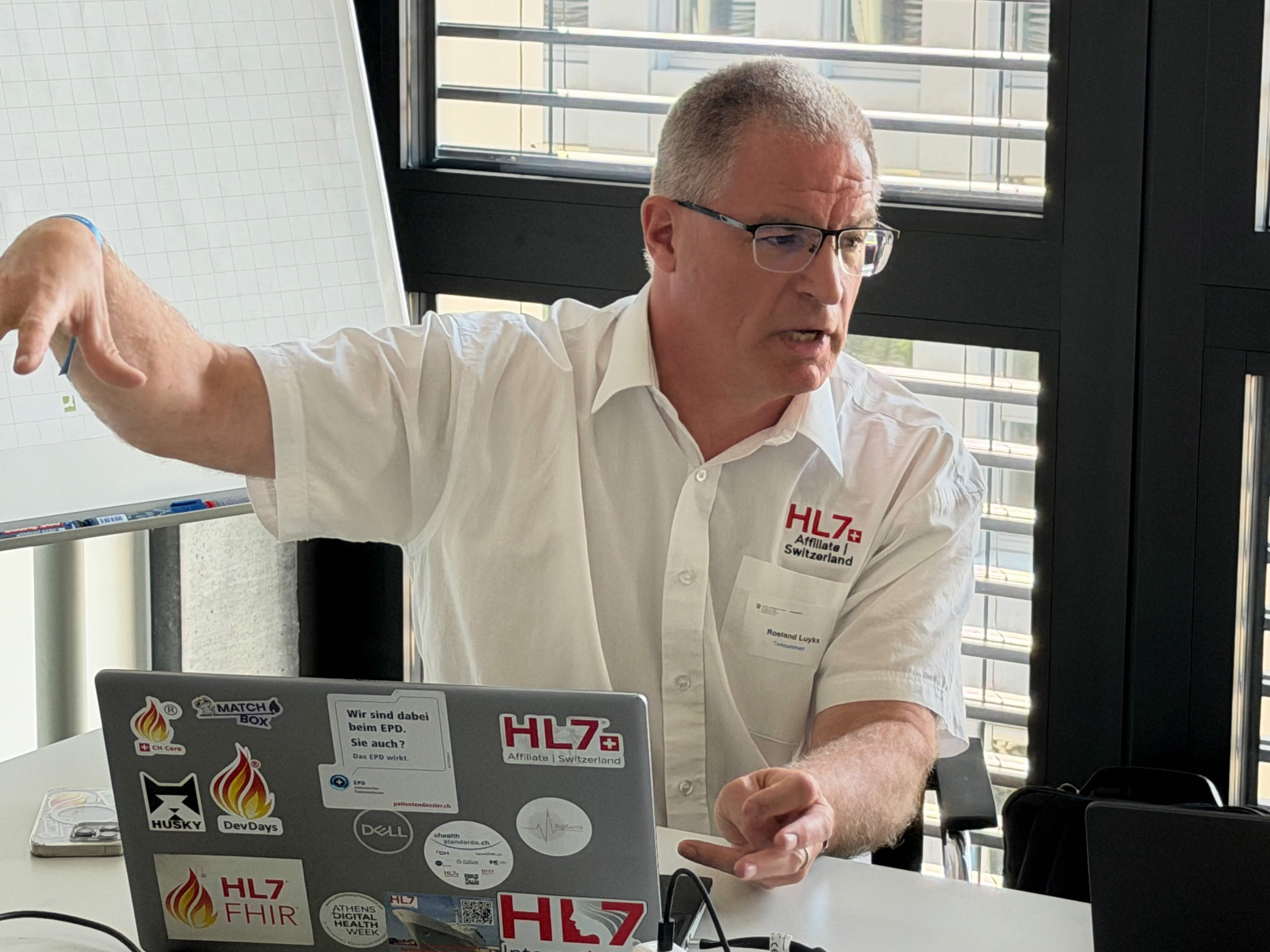
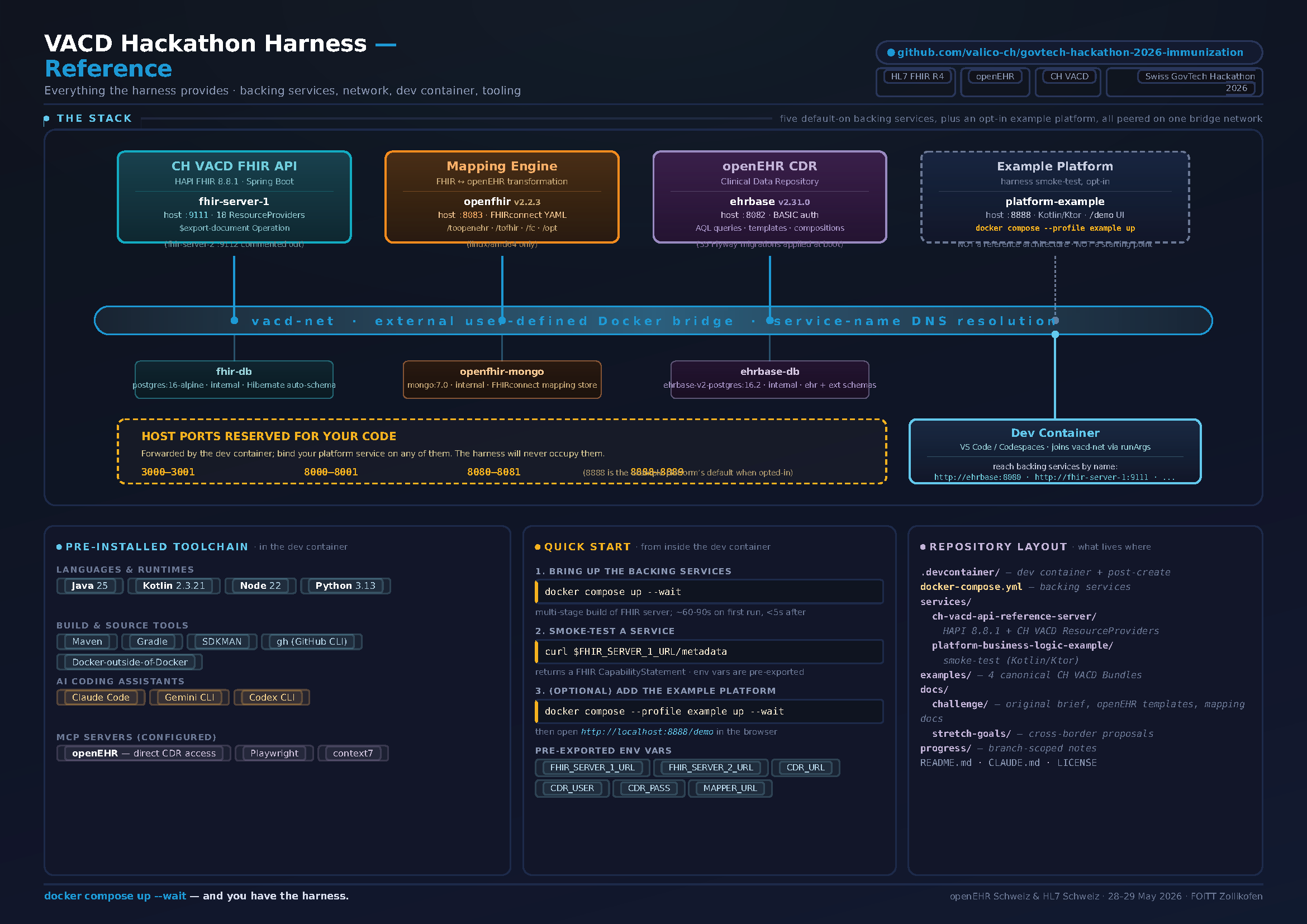
As it turns out, openEHR, FHIR and the development are all bearing considerable complexity.
After the intensive briefing, the team is quite overwhelmed - despite considerable preparations of our experts Jean-Pierre Messerli, Roeland Luykx and Oliver Deak in mappings, pre-built services and a development environment.
The assignment for lunch break is to think about the preferred tasks, matching the respective skills of the team members.
After lunch - tasks assignments
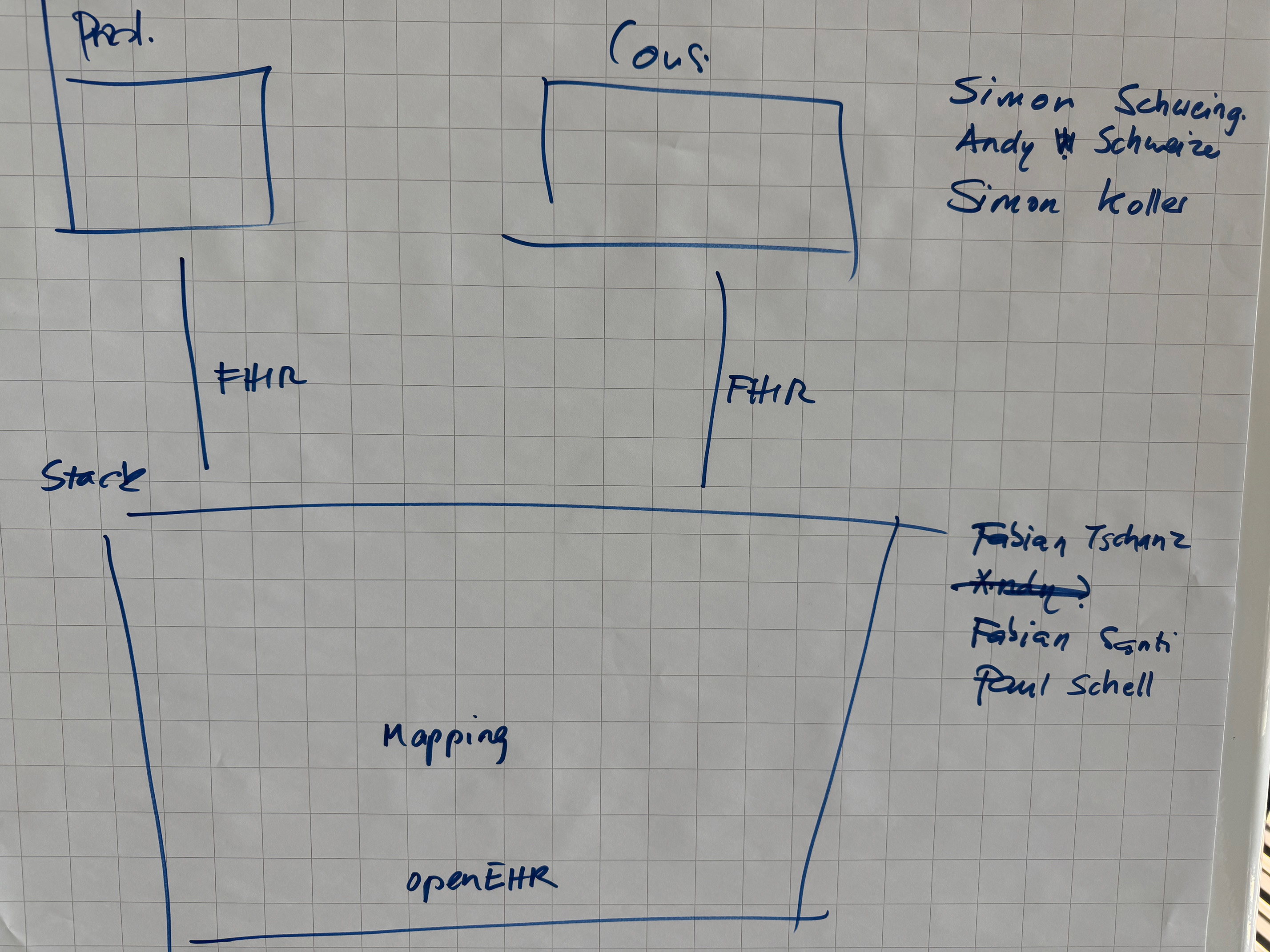
Coaching , starting work
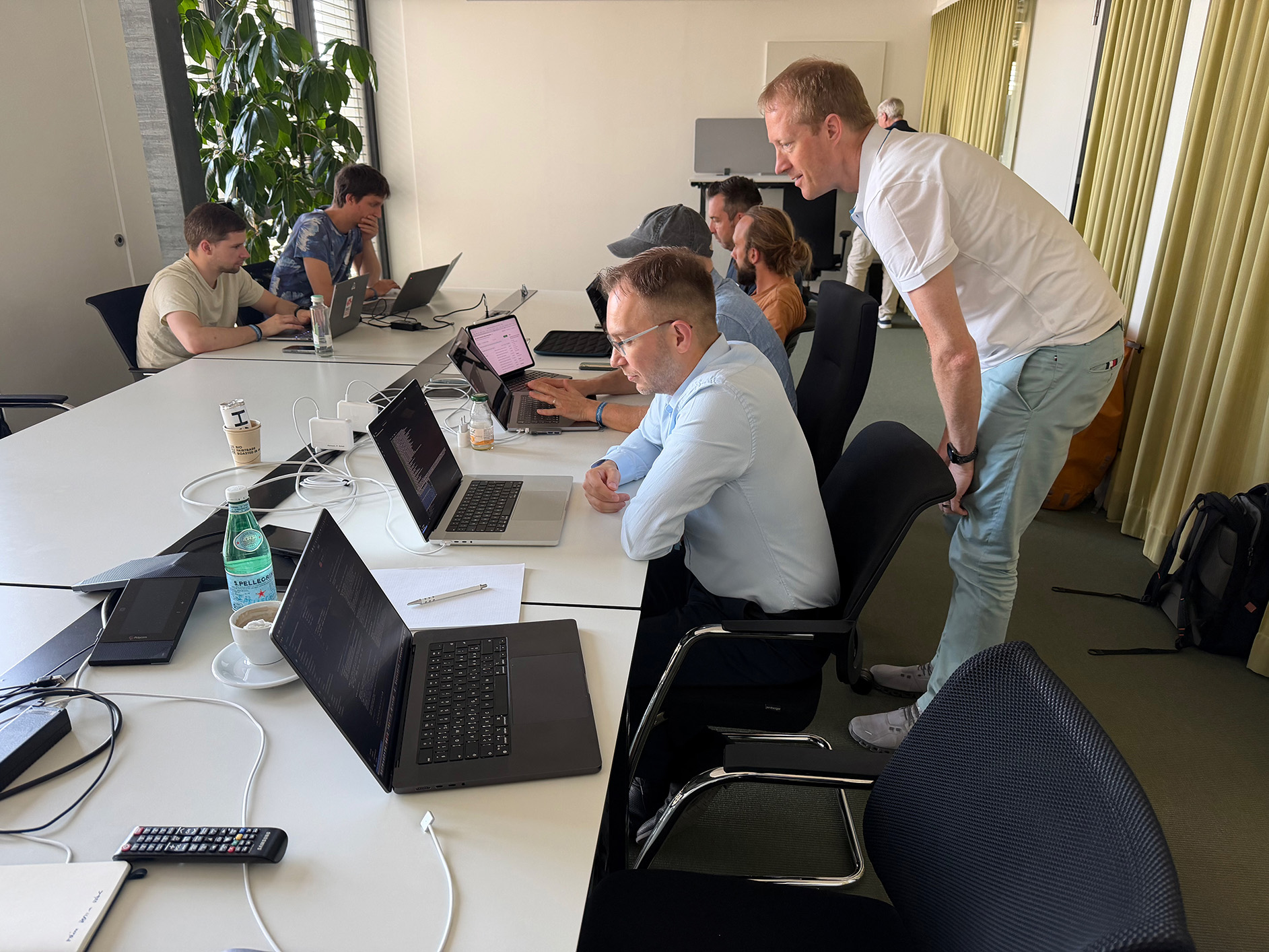
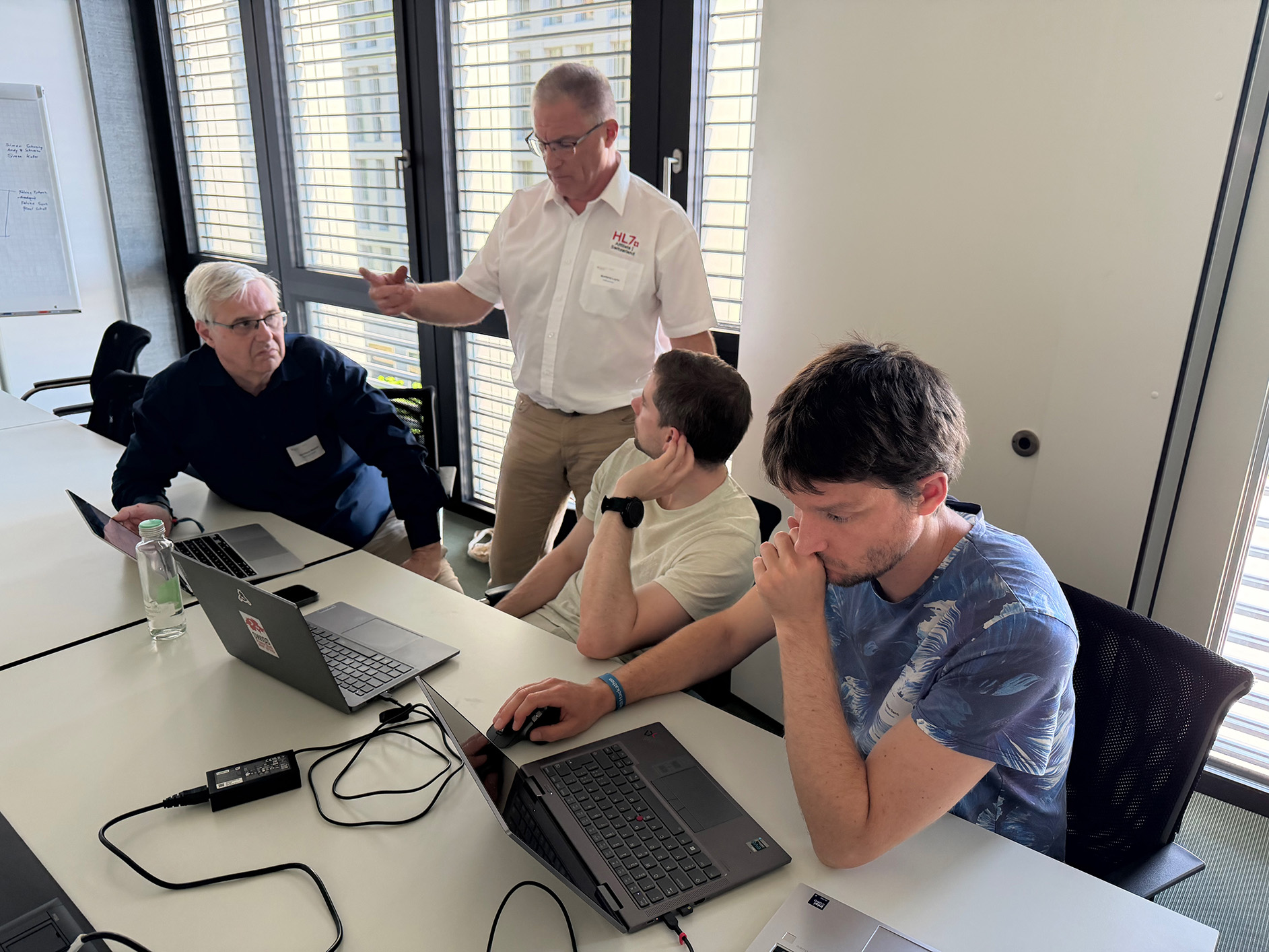
First part after assigning the tasks is «to get the hands dirty» with real code, with quite some coaching by our experts.
Discussing solutions
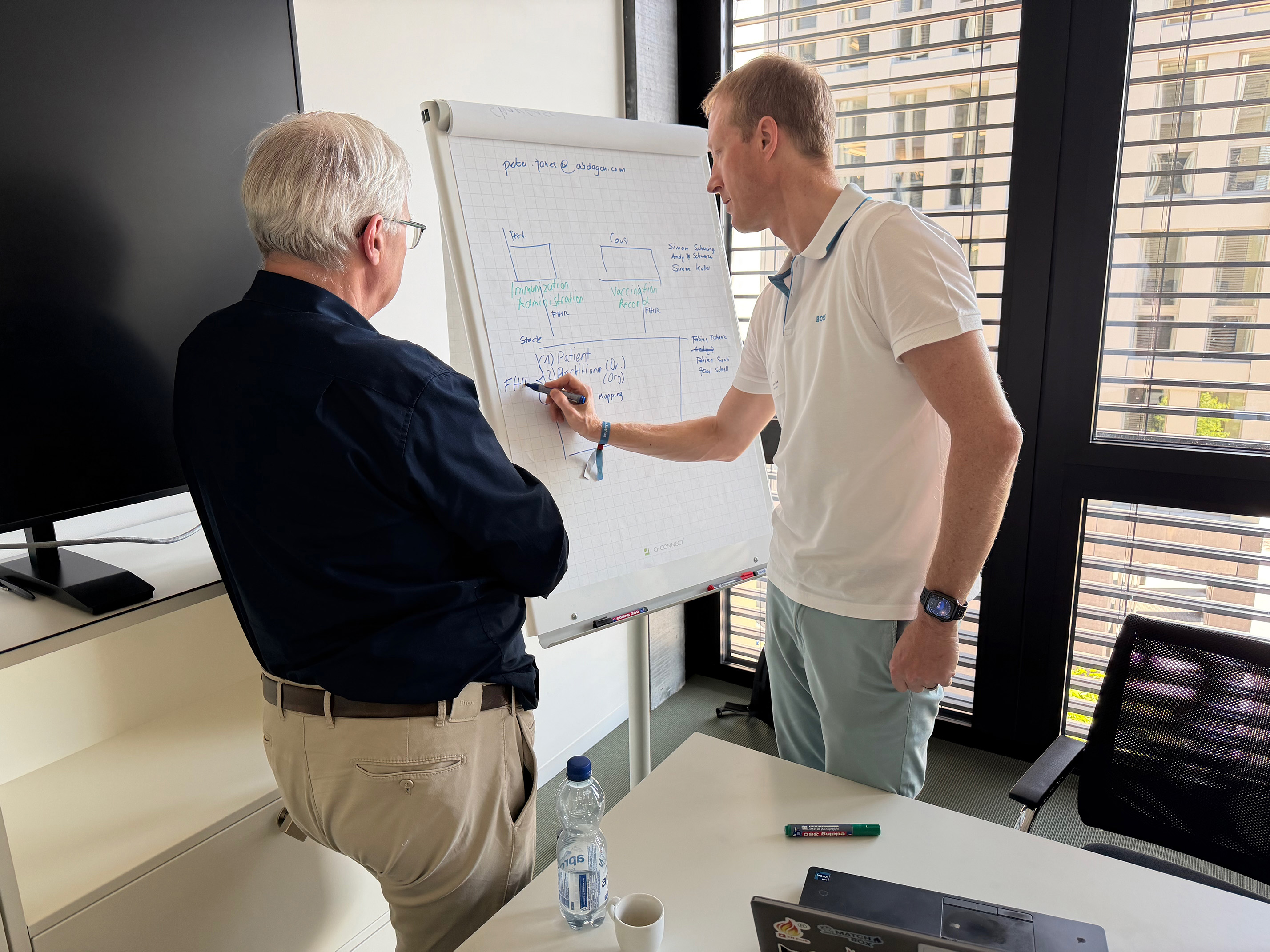
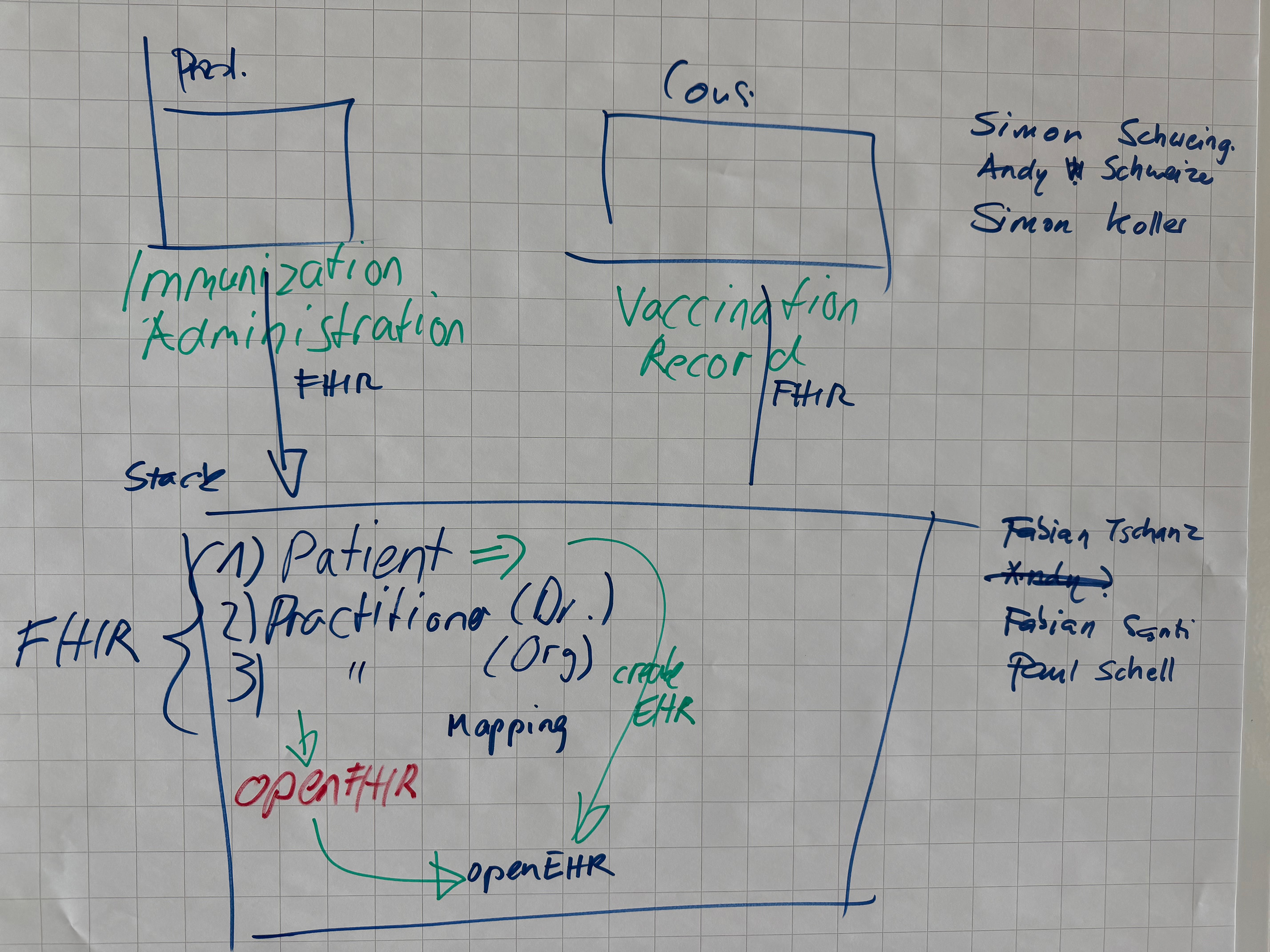
«Getting real» inevitaby raises questions about the most appropriate solution. That's the difference to just writing concepts.
29.05.2026 - Day 2
Briefing Call
Briefing chapters:
- 00:00:00 Intro
- 00:00:10 Welcome, Challenge Update - P. Janes
- 00:07:05 openEHR Perspektive - J.P. Messerli
- 00:10:45 FHIR Perspektive - R. Luykx
- 00:14:32 Technical Perspective - O. Deak
- 00:16:36 Wrap up - P. Janes
- 00:17:37 Adressing Questions
- 00:26:33 FOPH Perspective - P. Spicher
- 00:28:25 Next Steps, Ambition
- 00:34:40 International Interoperability
- 00:39:15 Outro
- 00:39:46 End
Results
Live Demonstration Flow
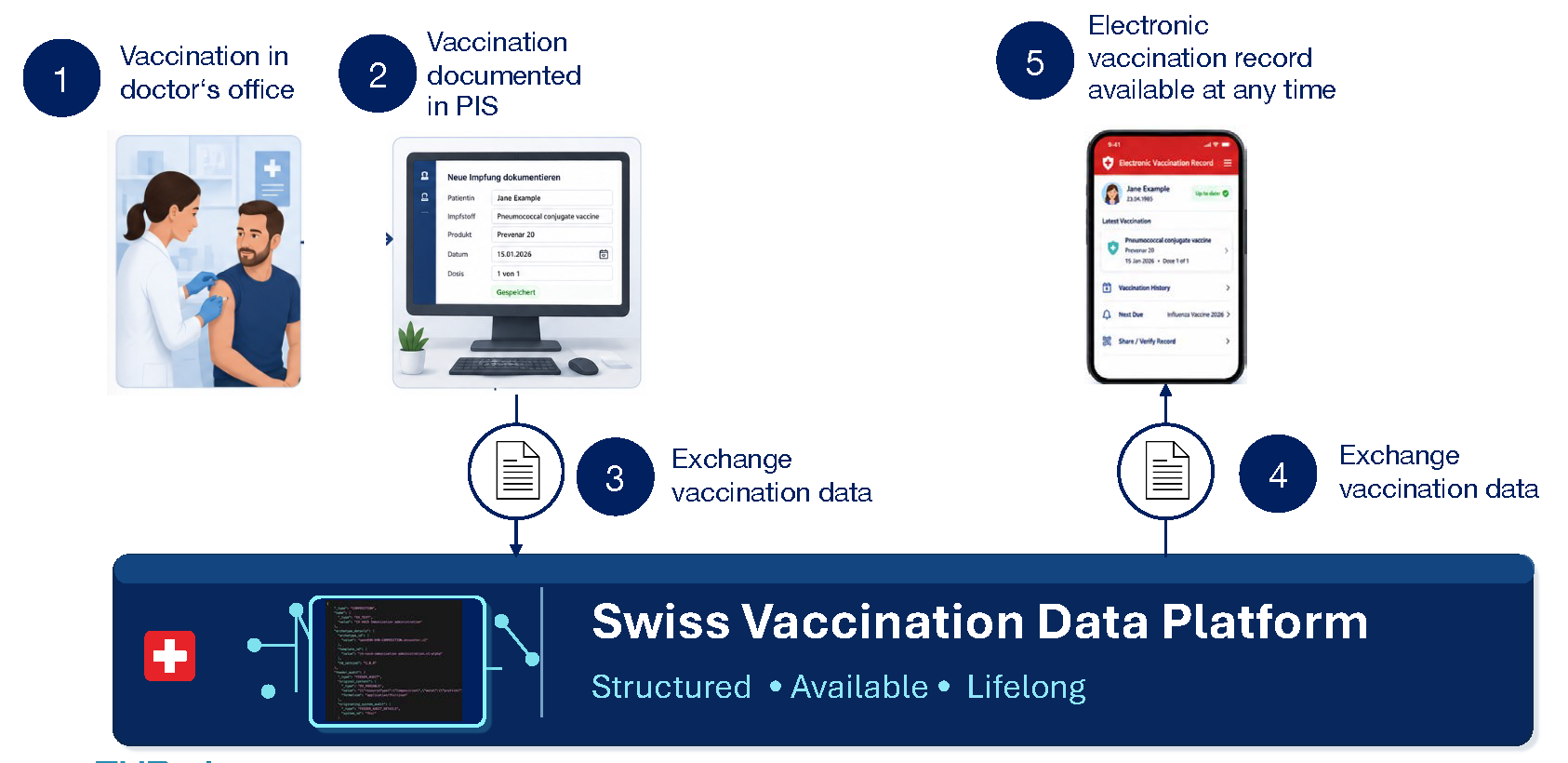
- Vaccination at doctor's office
- Vaccination documentation in doctor's system (PIS)
- Persist in structure form in «Swiss Vaccination Data Platform» through architecture stack
- Retrieve from «Swiss Vaccination Data Platform» through architecture stack
- Display vaccinations in citizen's app at any time
See final pitch recording for live demonstration.
Architecture Stack
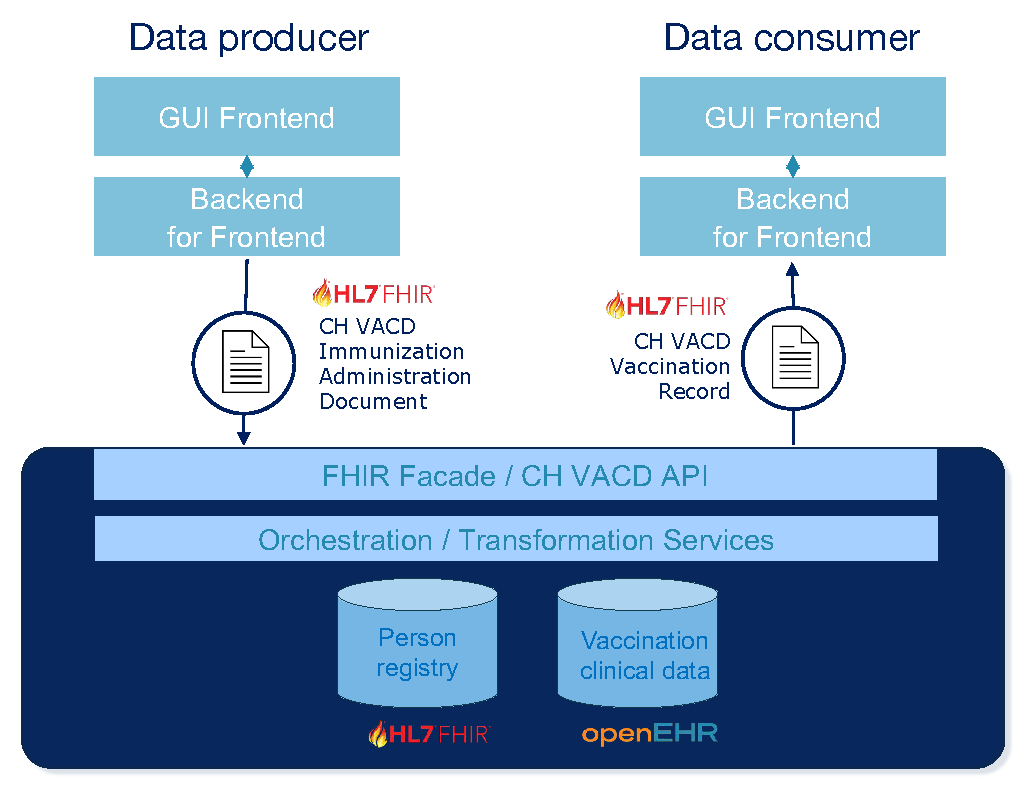
Relevant elements:
- Based on international standards
- Data Exchange - HL7 FHIR
- Data Persistence - openEHR
- Prerequisite for interoperability
- All components are open source
Takeaways
Key Takeaways
- It's complex - the learning curve to get into the architecture stack layers is steep
- It's running - within the two days of the hackathon, the full end-to-end prototype was implemented (based on substantial preparation work)
- It's clean - the prototype is based on the full architecture stack, which can now be used for other clinical use cases
Takeaways Breakdown
- Complexity – working with structured health data requires considerable domain knowledge and abstract thinking
- Preparation – both design and technical preparations were crucial to achieve the challenge objectives and results
- Team – highly motivated, software developers had very good technickal backgrounds, however getting used to digital health frameworks takes time and has a steep learning curve
- Coding – developing is increasingly library based and open source, Artificial Intelligence provides substantial support
- Blueprint – persistence design and modeling decisions are absolutely curcial, technology components are available, architectural structuring could be refined
- Awareness – conversations with FOPH, DigiSanté, and FSO took placebefore and during hackathon to inform about the initiative
- Pioneeering Work - as openEHR is rather new, not many comparable initiatives exist with the chosen end-to-end approach
Final Pitch


Previous
GovTech Hackathon 2026
Next project